
Automatic Product Management
Learn more about agile product management and how to use it.
Basic concept of product management
Service companies frequently offer subscription-based products such as licences, managed services or maintenance contracts that are billed on a recurring basis. Intelligent systems such as projectfacts help you to keep track of these products and evaluate their success.
While in manufacturing a glance at the warehouse is often sufficient to evaluate inventory and thus the success of a product, service providers face a different starting point: their products are not physically tangible – they cannot be stored or counted.
A further challenge with such products is that they have individual contract durations. A customer may, for example, purchase 100 licences for a service and at a later point add 20 further licences. The duration of the product therefore differs not only between customers, but also per licence.
To maintain an overview, service providers need specialised software that consolidates information from various orders. In this way, the history can be easily traced. You can see:
 •  Which products is the customer using?

 •  Since when and to what extent has the customer been using the product?

 •  How has the product scope changed over time?
In this way, companies not only keep track of ongoing contracts, but can also make well-founded decisions to optimise their products.
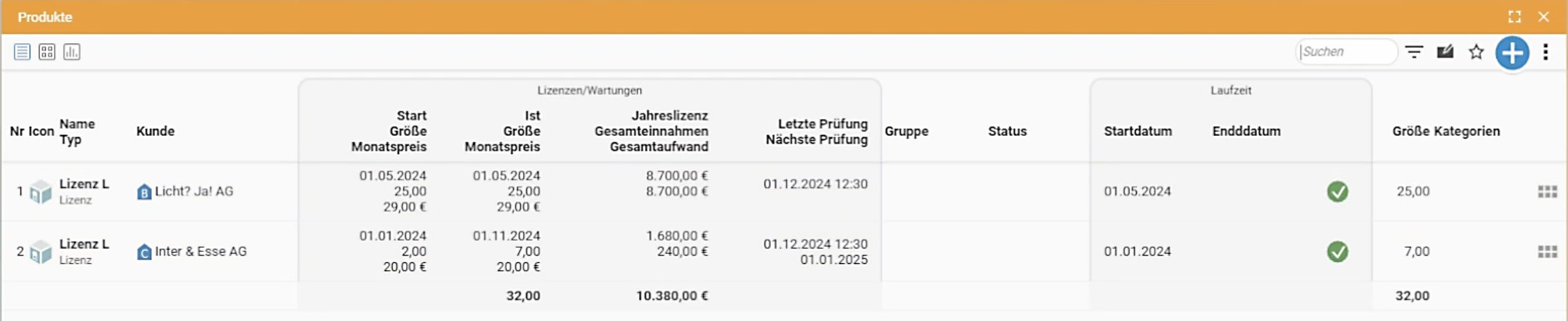
Application example: Software licences
Software licences are a classic example of the products offered by service companies. In return for a monthly or annual fee, customers receive the right to use a piece of software. However, important details – such as the agreed terms, the number of users or the contract start date – are often scattered across various orders. This makes finding such information frequently time-consuming and complex.
Product management offers IT companies a solution for managing licence products centrally. It extracts relevant information from different orders and presents it in a clear list. This allows companies not only to keep track of existing licences, but also to easily trace changes over time.
A particular advantage of product management lies in its transparency: if, for example, the number of licensed users has been adjusted several times over time, this can be traced with just a few clicks. Product management thus supports companies in efficiently managing licence products and improving customer service.
Automated product management: New features for greater efficiency
Product management offers IT companies a solution for managing licence products centrally. It extracts relevant information from different orders and presents it in a clear list. This allows companies not only to keep track of existing licences, but also to easily trace changes over time.
Now the system goes one step further: products can from now on also be created automatically for existing orders. All you need is a product template, in which you define which items should be assigned to a product – for example monthly, quarterly or annual licences.
After creating the template, the system searches all existing orders in an automated run. As soon as a matching item is identified, the system automatically creates a product and assigns it to the corresponding customer. In this way, you can quickly and easily create products not only for new orders, but also for existing customers. With just one click, you receive a complete overview of all products currently in use by your customers.
By activating the automatic update, this process is repeated on a regular basis. The system automatically adds new products that have been commissioned in the meantime, keeping product management always up to date – without any additional effort on your part.
Product history at a glance
The product history allows you to precisely trace the development of product usage among your customers. You can see at a glance when licences were added or cancelled and how many licences are currently active – this calculation is performed automatically based on the contract durations.
In addition, the Document Positions tab provides an overview of which services have already been billed and which are still outstanding. This gives you complete control over product management at all times.
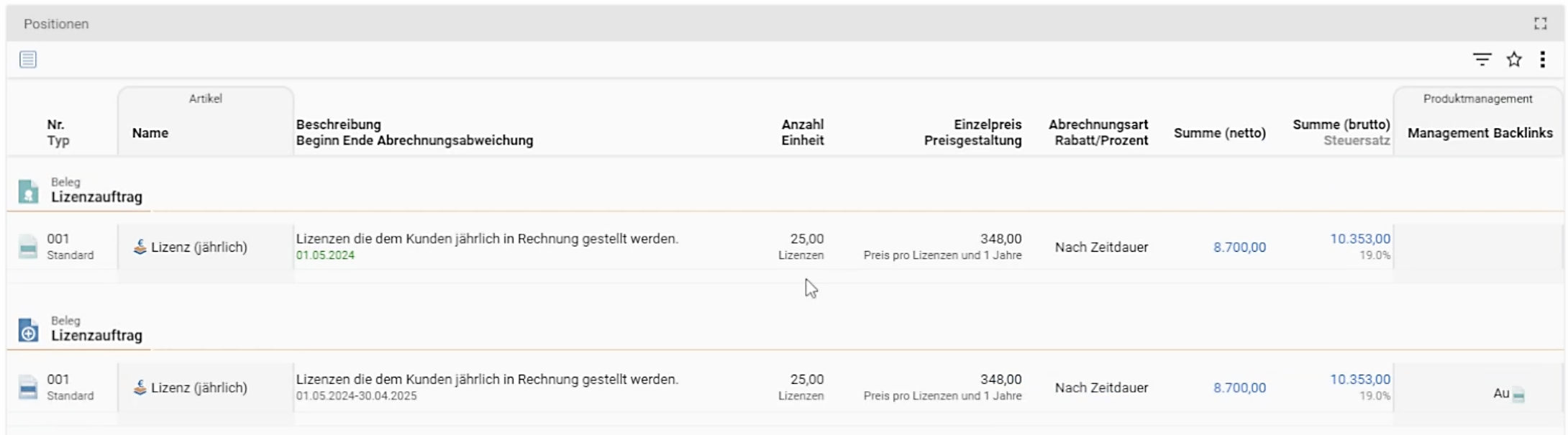
You can see how to set up product management in the software in the following video.
Further features of product management
Automatic product creation is just a small part of the module. You can discover many more exciting features such as automatic orders, maintenance positions and more in the following videos ( click here) or on our information page on product management.