What is a Quotation? Definition and meaning
Once a potential customer has expressed interest in purchasing a product or service, the company prepares a quotation. It includes a description of the service to be provided, as well as the calculation of the price to be paid by the client if they decide to place an order.
Quotation vs supply and special offer: which one is meant
In German, the word for quotation (“Angebot”) is also used in economics for the quantity of goods supplied, in the sense of “supply and demand”, and in retail for a discounted special offer. In this article and in the business software, however, it refers to the commercial sales quotation: the document with which a provider offers a customer a service at a calculated price.
Types of Quotations
In general, four different types of quotations are distinguished:
Standard quotation
The standard quotation encompasses all service packages that the company typically combines in a quotation. It does not contain any special customer requests, discounts or other adjustments.
Special offer
The special offer is often associated with discounts. In fact, it often refers to particularly low prices that are below the level of the standard quotation. Special offers can, however, also differ from the standard quotation in other terms, for example in the form of better return conditions. Special offers are generally limited in time.
Tender quotation
Tender quotations are prepared for public or semi-public contracts in the service sector. A characteristic feature here is that certain framework conditions of the quotation are stipulated in advance by the tendering party. Potential contractors must then align their quotation with these framework conditions. This often severely restricts the scope for the quotation and reduces the selection to the lowest price. In particular for public sector tenders, there are clear guidelines on the awarding procedure.
Loss leader offer
The loss leader offer is a special offer aimed at attracting potential customers. It is usually attractively priced and is intended to generate attention for the provider. Due to high demand, loss leader offers are often sold out very quickly. Nevertheless, the provider hopes that the signal effect will also boost sales of other products (“cross-selling”).
Legal Aspects of Quotations
Submitting a binding quotation also creates obligations: the provider commits to carrying out the offered order as set out in the quotation, provided the customer has accepted the quotation. In that case, the contract has been concluded with legal effect.
As an alternative to a binding quotation, the quotation can be declared “subject to change” or “non-binding”. As a rule, quotations contain, in addition to the description of the goods or service, also the specification of payment and delivery terms and a validity period, the so-called quotation binding period.
Structure of a Quotation
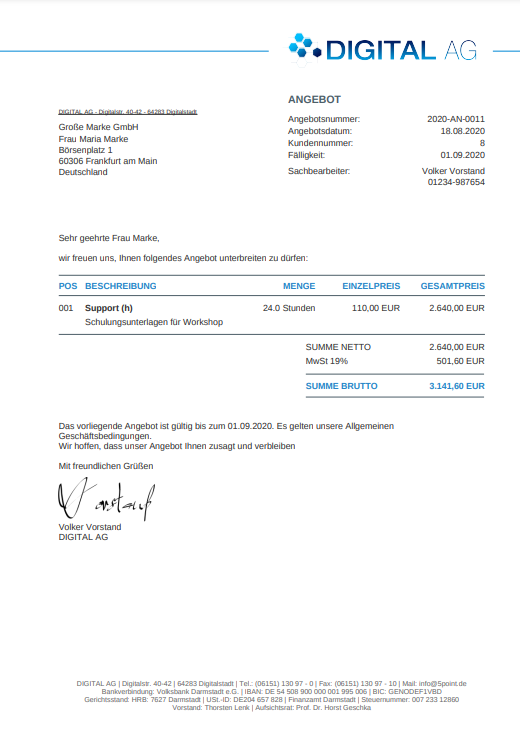
Essentially, the structure of a quotation corresponds to that of an invoice. I.e. at the top are first the addresses of the sender and recipient, followed by the salutation and a brief introduction. The main part consists of the individual quotation line items. Care should be taken to state quantities, prices and discounts as transparently as possible. The closing consists of a closing formula and the provider’s contact details.
Stating a quotation number or quotation ID facilitates communication with the customer. Since quotations have a standardised structure, quotations can be created quickly and easily with suitable software. Numbers, addresses, contact details, quotation line items and much more can be transferred automatically. This also makes offer tracking over time easier.
Detailed quotations can, in addition to the standard components described above, contain further parts, for example:
- A presentation of the provider’s capabilities and qualifications, e.g. in the form of reference projects
- An explanation of the approach for the task defined in the quotation
- A calculation showing various variants or optional components
- The General Terms and Conditions (GTC).