What is an Order? Definition and meaning
When it comes to an order, a distinction must be made between a legal and a commercial definition. Under the German Civil Code (BGB), an order is a contract concluded between a client and a contractor. The contractor commits to rendering the contractually agreed service free of charge.
In a commercial context, this is usually not the case. Instead, an explicit consideration is required for the rendering of the service: typically a monetary fee. In the following, “order” always refers to this form of “customer order.”
Fundamentals of an Order
As a rule, an order is preceded by a quotation. This quotation, submitted to the prospective customer by the company, then forms the basis of the order. When the customer places the order, a contract is formed. This obliges the contractor to render the service defined in the order. In return, the client also fulfils the performance defined for them, usually in the form of payment.
An order is therefore a contract initiated by the client and confirmed by the contractor, in which the contractor commits to delivering a defined scope of services. As a rule, the scope of the order also varies with the scope of the services.
In a simple online ordering process, for example, the order data is limited to a brief overview at the end of the checkout. If, on the other hand, the order relates to a complex B2B service, the associated document can quickly become very extensive.
Content of an Order
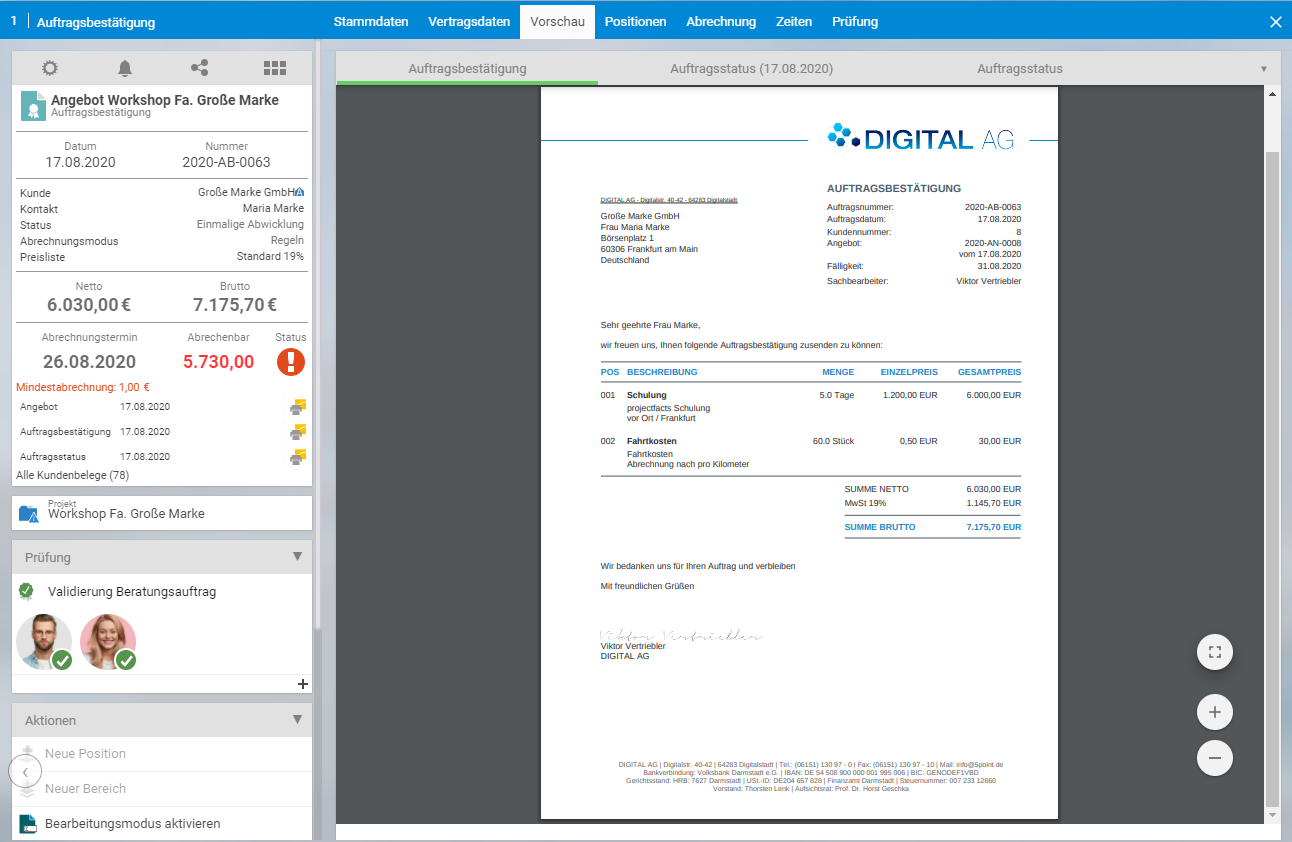
Certain typical elements, however, are always found in an order regardless of its size:
- Addresses of the client and contractor
- Order number and date
- Items ordered under the order, with prices and quantities
- Total value of the order
- Delivery and payment terms
It is common practice to acknowledge a customer order with an order confirmation. The order confirmation is formally not a “legal document” but rather a declaration of intent or statement of intent to fulfil the order as placed by the customer. In the simplest case, the order confirmation can be given verbally (as is often the case in retail), by email (for online orders), or by post.
For more complex services, the order also forms the basis for a project. For this reason, the customer order is often referred to as a project order. Some software tools therefore offer an integrated solution that not only allows orders to be managed but also enables the user to automatically create projects on the basis of orders and post recorded working hours against them.