What is a Process Plan? Definition and meaning
The purpose of the process plan is to document the individual steps of a project that were planned in advance. Within project management, main tasks are defined, which are in turn broken down into individual work steps. The process plan does not have a fixed prescribed form. Nevertheless, some presentation formats have proven helpful in practice and have established themselves over time. These include in particular the Gantt chart (sometimes also referred to simply as a bar chart) and the network diagram.
Creating a Process Plan
When creating a process plan, the primary question is which steps need to be completed for a successful project closure. Instead of a simple list, a process plan typically links sub-projects, work packages and milestones in terms of content, time and logic. The process plan therefore also documents the mutual relationships and dependencies of individual work packages and/or sub-projects.
A process plan can also be used in other areas, e.g. in sales and for decision-making.
Objectives of the Process Plan
It is often the case that certain work packages stand in a particular logical relationship to one another. For example, walls cannot be plastered before they have been built. The roof can only be completed once the tiles have been ordered and delivered. Such logical and temporal dependencies between individual work steps can be recorded in a process plan.
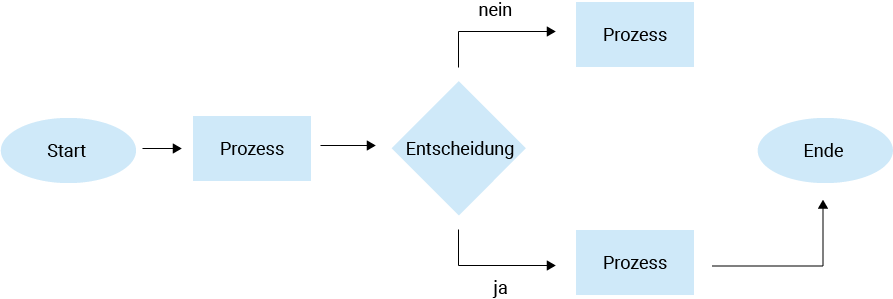
Furthermore, decisions often need to be made within projects. The owner may decide at short notice to add an extra wall on the first floor or to relocate water connections. Such decision situations can also be mapped with a process plan.
Decisions in turn cause the process plan to branch into various sub-trees that can proceed differently. As a result, process plans can quickly become quite complex. All the more important, then, is an adequate project management solution that breaks down the complexity for the user.