
Business Software for the DACH Region
Whether you invoice abroad or employ staff at locations in several countries: projectfacts maps the differences. At home in Germany, Austria and Switzerland.
Get in touch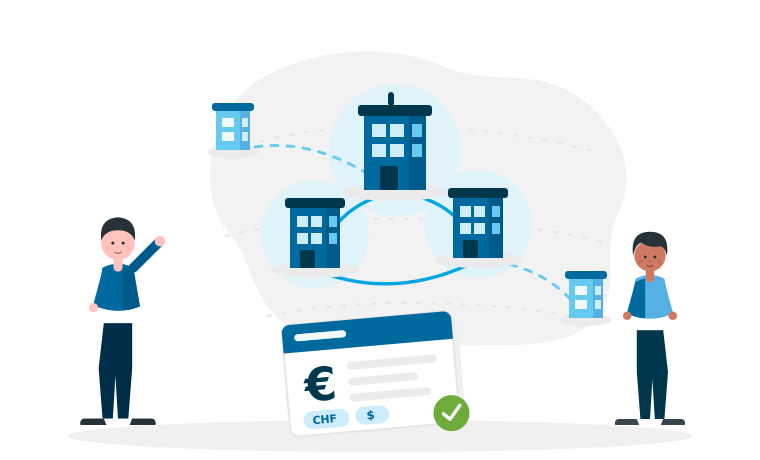
One economic area, many sets of rules
Working across borders is the normal case
Europe is a shared economic area, but not a shared set of rules. Goods and services flow across the borders, while language, currency, tax law and employment law stay national. Switzerland also sits outside the EU, which makes every invoice going there a third-country case.
For most companies this has long been everyday business, small ones included. A client in Vienna, a developer in Zurich, a branch in Paris: that does not call for a corporate programme, but for software that knows the differences instead of levelling them out.
projectfacts is at home in the DACH region. Germany, Austria and Switzerland are our three main countries, and a great many of our customers are based directly in Zurich, Vienna or Salzburg. Where further countries come into play, they are as a rule branches of a parent company in the DACH region, in France or the United States for example.
Two situations, and usually both at once
Situation A: locations in several countries
You employ people across the border. Different vacation models, public holiday calendars, break rules and working time requirements then run side by side, permanently rather than as an exception.
Situation B: clients in several countries
You invoice across the border. What matters then is not only the tax rate but the reason the tax does not apply, along with the currency and the language in which your client reads the document.
Usually both at once
Anyone with staff abroad usually has clients there too. Running both cases in separate systems means maintaining everything twice. projectfacts covers them in one system.
At home in the DACH region
One misunderstanding first: projectfacts is not a German-only piece of software. A substantial share of our customers is based directly in Switzerland and in Austria, with Swiss bookkeeping, Austrian working time law and the local particulars of day-to-day business. Germany, Austria and Switzerland are our three main countries, and for all three the necessary parts are built in rather than retrofitted.
That holds geographically too. Besides our head office in Darmstadt we run a branch with a training centre in Lindau on Lake Constance, right where the three countries meet. From there it is about 15 minutes to Vorarlberg and a good half hour into eastern Switzerland, so training sessions and meetings on site do not take a full day's travel.
The three main countries in detail
Germany
E-invoicing in ZUGFeRD and XRechnung, DATEV integration including Unternehmen Online, public holidays per federal state and a data centre in Frankfurt am Main.
projectfacts in GermanySwitzerland
Swiss QR Code, rounding to 5 Rappen, Swiss number format and a bookkeeping export that adapts to your chart of accounts. Its standing as a third country towards the EU is mapped properly as well.
projectfacts in SwitzerlandAustria
Service impediments and notional standard working time under Austrian rules, driving times of driver and co-driver, and vacation years you define freely.
projectfacts in AustriaBranches beyond that
Where a subsidiary in France or the United States is added, foreign currency, freely defined vacation and break rules and the configurable bookkeeping export apply regardless of the country. There is no separate country page for these cases because the building blocks are the same: you set up the rules that apply there and assign them to staff and documents.
Where it gets specific, we sort it out in conversation. Tell us which countries come together in your business and we will look together at the settings your case needs.
What to consider in the two situations
The sections below work through the points where countries genuinely diverge: first staff at several locations, then invoicing across the border, followed by currencies and exchange rates and the way language, numbers and dates are displayed.
Staff at several locations
Anyone employing staff in several countries cannot treat vacation and working time as one and the same.
Vacation models side by side
You set the vacation year and the point of expiry per rule and activate the rule per employee. Different models then run side by side within one company. More on this in vacation management.
Working time under local rules
Special forms of working time can be handled separately, for example absences under Austrian rules or driving times of driver and co-driver. The basics are on the working time recording page.
Assignment with an effective date
Vacation rules, break rules and public holiday calendars are set up centrally once. They are assigned through the individual employee's contract data, together with weekly working hours, vacation days and the expiry setting. Each of these records carries a valid-from date and, where needed, a valid-to date, so several periods follow one another.
That covers the cases rigid systems fail at: an employee works in France for a year and then comes to Germany, or moves within Germany to a federal state with different public holidays. You add a new period starting from the move. From then on the new rules and the new public holiday calendar apply, while the months before it stay under the previous ones. Nobody needs a second employee record for this, and reporting across the full year stays correct.
Breaks under local rules
The minimum break is one of the points where countries diverge noticeably. In Germany, 30 minutes apply from more than six hours of working time and 45 minutes from more than nine hours. Austria likewise requires 30 minutes from more than six hours, but allows the break to be split into shorter parts. Switzerland staggers more finely and starts at a quarter of an hour from more than five and a half hours, up to a full hour from more than nine hours. In France it is 20 consecutive minutes as soon as daily working time reaches six hours.
In projectfacts you map this with break rules, and you can have any number of them. Each rule is a table with two columns, valid from working time and minimum break, and it takes any number of steps. The German requirement sits in it as two rows, 6:00 hours with 30 minutes and 9:00 hours with 45 minutes. The Swiss staggering simply gets one row more, the French one manages with a single row. So you set up a separate rule per country and assign it through the employee's contract data, along with the vacation rule and the public holiday calendar. What applies to your company follows from the respective national law and from any works agreement. How breaks arise and are adjusted in day-to-day operation is covered on the working time recording page.
Public holidays per location, including half and quarter days
The stored public holiday calendar reaches at least two years into the future and reports back by itself when it runs out. National and regional holidays are maintained separately, so locations are mapped correctly.
A public holiday is not necessarily a whole day. Depending on country and region you keep it as a whole, half or quarter day, much as Christmas Eve and New Year's Eve are treated in many companies anyway. The deduction from the vacation account follows suit.
Vacation in half and quarter days
Where part days are common, a whole vacation day is not a small enough unit. In projectfacts, staff take vacation in parts as well, as a half or quarter day. The same applies to special leave and to taking time off in lieu of overtime.
Travel expenses abroad
In travel expense reports you take country-specific meal allowances and VAT rates into account.
Invoicing across the border
The tax case decides what appears on the invoice and which account the item lands on. In projectfacts, the two belong together.
Tax case and contra account
Where the tax does not apply, you assign the reason its own contra account: services to other EU countries subject to a recapitulative statement, services to non-EU countries, sales taxed in another EU country, or another reason for exemption. The postings then arrive in the export already sorted. More on this on the invoicing page.
Notes in three languages
Every reason for exemption comes with a note on the invoice, for example on the reverse charge procedure under § 13b UStG. You store these texts in German, English and French. The matching text appears automatically as soon as the document carries the corresponding tax case.
Making payment easier
On request, every invoice carries a payment code with which your customer prepares the transfer by scanning: GiroCode for the euro area, Swiss QR Code for Switzerland.
Price lists carry language and currency
Every price list carries a currency and a language. You create as many price lists as you serve markets and assign them per customer, country or period.
The practical effect shows in a quote: switch there from the Switzerland/German price list to England/Pound and the entire document is immediately in the other language and with the prices of the other currency. Nobody builds a second quote, and nobody converts by hand. This applies to all languages and all configured currencies. How quotes are created otherwise is shown under quotation preparation.
Currencies and exchange rates
A company has exactly one house currency in which it reports. Everything else may differ from it: individual projects, individual documents and above all the view of the individual employee.
Any number of currencies alongside the house currency
You create as many currencies as you need. It is not only invoicing that supports currencies: projects have their own currency too, and payments to employees can be made in a different one. The department in Berlin can therefore plan in euros while head office in Zurich keeps the franc as its house currency.
Every user sees their own currency
So that nobody has to convert in their head, each user picks the currency in which figures and reports are displayed in their personal settings. The company's house currency is unaffected by this.
Rates with a history, not a snapshot
The history of exchange rates is stored. Invoices, projects and costs are therefore converted at the rate belonging to their date, not at today's. You enter rates accurate to six decimal places.
Language, numbers and dates per user
In international work, understanding rarely fails because of a function. It fails because of presentation. A date such as 03/04 means two different days in Germany and in the United States.
What everyone sets for themselves
In their personal settings, each user defines language, time zone and country, plus the start of the week, the date format, whether times appear in 12 or 24 hours, the time format for hour values, and currency and currency format, meaning the separators for thousands and decimals.
Why this is more than cosmetics
The same report then reads in a familiar form for the colleague in Vienna, the colleague in Zurich and the team in the United States, without anyone maintaining a second set of data. The figures behind it stay the same.
Time zones in a distributed team
Presentation includes the time zone. Every user stores their own, and lists, calendars and reports follow it. Recurring appointments spanning the change between summer and winter time are handled accordingly, even when participants sit in time zones without such a change. Calendar synchronisation via CalDAV supports time zones as well.
Three examples from practice
How these building blocks work together only becomes clear in a concrete case.
A US branch inside the German parent's system
The subsidiary in the United States works in the same system as the parent company in Germany. Its staff enter and see everything in dollars and issue invoices in dollars with the tax rates that apply there. Head office looks at the same data in euros, including the revenue reports, converted at the rate applying on each date.
Head office in Zurich, department in Berlin
The house currency is the franc. The Berlin team still plans its projects in euros because it buys and invoices in euros. Both sides see reports in their familiar currency, without separate systems or intermediate spreadsheets.
A service provider with clients inside and outside the EU
A German consultancy invoices clients in Austria, Switzerland and the United States. Each tax case gets its own revenue account, the note on the reversal of tax liability appears automatically in the recipient's language, and the postings arrive sorted in the accounts.
All the differences at a glance
For reference once more in compact form: on the left what differs from country to country, on the right the setting you use to map it in projectfacts.
What differs from country to country, and where you set it in projectfacts
| Differs from country to country | Where you set it in projectfacts | |
|---|---|---|
| Vacation year | The vacation year does not start in January everywhere. | You define the period of a vacation year freely. This is also how the French vacation model is supported. |
| Expiry of remaining leave | When unused vacation expires differs from country to country. | You determine the point of expiry yourself. Vacation rules are activated per employee, so several models run side by side. |
| Public holidays | Not every public holiday is a whole day. Some countries and regions have half or quarter holidays. | You keep public holidays as whole, half or quarter days. Calendars are maintained per location and carried forward. |
| Part-day vacation | Where half or quarter days are common, a whole vacation day is not a small enough unit. | Vacation can be taken in parts, as a half or quarter day. The same applies to special leave and to taking time off in lieu of overtime. |
| Minimum breaks | When a break falls due and how long it has to be differs from country to country, and is often staggered across several thresholds. | A break rule is a table with the columns valid from working time and minimum break, and it takes any number of steps. You set up any number of such rules, for instance one per country, and assign them through the contract data. |
| Change of location | Anyone moving to another country or federal state comes under different public holidays and different rules from the date of the move. | The vacation rule, the expiry setting, the public holiday calendar and the break rule belong to the employee's contract data, and that data applies from a given date. From the move onwards the new set applies, and the period before it stays as it was. |
| Tax exemption on the invoice | Whether and why VAT does not apply depends on the destination country. | You record the tax rate on the article. Each reason for exemption is assigned its own contra account, separately for sales and purchasing. |
| Notes on the invoice | The note on the reversal of tax liability has to be readable for the recipient. | For every reason for exemption you store a note in German, English and French, worded to suit your requirements. |
| Quotes in the customer's language and currency | A customer abroad expects the quote in their language and their currency. | Every price list carries a currency and a language. Switch the price list in a quote and the whole document switches with it, in language and in prices. |
| Currency and rounding | Not everyone calculates in euros and down to the cent. | You show amounts in foreign currency, and costs are converted. For document creation you define a smallest currency unit, for example 5 Rappen. |
| Display currency | Head office works in a different currency from the branch. | Alongside the house currency, every user picks the currency in which they see figures and reports in their personal settings. |
| Exchange rates | Rates change, yet old documents still need the rate that applied back then. | The history of exchange rates is stored. Invoices, projects and costs are converted at the rate belonging to their date, accurate to six decimal places. |
| Numbers, dates and language | Date notation, decimal separators and the start of the week differ considerably around the world. | Language, time zone, country, start of the week, date and time format as well as the currency format are set by each user individually. |
| Time zones | A team spread across time zones books times, appointments and documents at different local times. | Every user stores their own time zone. Lists, calendars and recurring appointments follow it, including across summer and winter time. |
| Bookkeeping export | DATEV is a German standard. Abroad, your accounting department works with other programs. | Alongside the DATEV interface there is a list export where you decide on columns, date format, file name and character encoding. |
| Financial year | The financial year does not start in January in every company and country. | You store the start of the financial year centrally for the booking export. |
Do you work across borders?
Tell us which countries come together in your business. In a conversation we will show you how your cases can be mapped in projectfacts.
Get to know us