
Acquired: keep your software or replace it?
After an acquisition, almost the same instruction always follows: from now on the buyer's system applies. Before you switch off a solution that works, a sober review is worth the time, because in most cases the group only needs your figures, not your processes.
Arrange a meetingDoes an acquired company have to move to the buyer's software?
Not necessarily. In most cases the group needs two things: the financial data in its accounting system and a few key figures for reporting. Both can be handed over without the company changing its operational system. The buyer gets its standardisation where it takes effect, at the level of the figures. The company keeps the processes it was bought for.
This page is there to help with that review. It sets out what a replacement actually costs, in which cases it is nevertheless the right move, and which questions should be asked in the talk with group IT. It is written to be forwarded.
Two levels, two completely different requirements
The group level needs figures
Accounting records, consolidation, key figures at the reporting date. Standardisation makes sense here and is easy to achieve.
The company needs processes
Projects, times, tickets, billing. This is where the business sits that the company was bought for.
In between, a handover is enough
A defined interface instead of a change of system. Narrow, plannable, set up within weeks.
The question that comes before the business case
Before anyone works out whether a switch pays off, another question needs answering: can the target system cover a German company completely at all? Buyers who acquire internationally are often not familiar with the German specifics, not out of carelessness, but because those specifics play no part in their home market.
Three points that deserve checking
First, electronic invoicing: since 1 January 2025, companies based in Germany have had to be able to receive and process e-invoices in the B2B sector, and from 2028 the obligation applies to all domestic B2B turnover. In Germany the formats mainly in use for this are ZUGFeRD and XRechnung. The details are set out under e-invoicing and in the article everything about e-invoices.
Second, accounting: in Germany the tax adviser as a rule works with DATEV. If the matching export is missing, that work does not become less, it simply moves somewhere else, every month, by hand. How the handover works in projectfacts is described on the page about the DATEV interface.
Third, working time: separate requirements apply in Germany to the recording of working time, as set out under the obligation to record working time.
Why this changes the order of the conversation
As long as the discussion circles around costs and habits, it is one opinion against another. As soon as it turns to requirements that have to be met, it is no longer a matter of taste. The task is then no longer to justify why the company would like to keep its system, but to demonstrate that the target system covers the requirements. That evidence should be on the table before a switch-off date is set.
What the buyer really needs, and how it gets it
The most important part of this page is not the objection but the alternative. It is concrete, and every building block is an existing function.
Financial data for the group's accounting
Accounting records, receivables and documents go to accounting or to the tax adviser through the DATEV interface. For Austrian companies, the BMD interface does the same job. Where a different chart of accounts applies, the export is set up accordingly.
Key figures for group reporting
Revenue, utilisation, project status and times go to the group's reporting at the reporting date, either through the REST API or as a report, as described under Power BI and export. The run is scheduled, so nobody has to be reminded of a monthly submission.
Sign-in and permissions
Sign-in runs through single sign-on with the Microsoft 365 account, see Microsoft 365. Anyone who leaves the company loses access in the place where the group administers it anyway.
Currencies and countries
If the company is going to belong to a foreign parent, foreign currency and differing rules come into play. Revenue can be converted at the rate of the document date, so that head office looks at the same figures in its own currency. What can be configured here is set out under international use.
What a replacement costs: the items that rarely appear in the budget
A change of system is usually compared on licence costs. That is the smallest part of the calculation. These items are frequently missing from the sums, even though they do arise.
One-off costs
The selection and migration project itself, running both systems in parallel during the changeover, the data transfer and the training of all employees. On top of that comes whatever has to be rebuilt in the target system because it is not provided for there. In our experience, adjustments of that kind are the single largest item.
What does not come along
History, documents, time series and project archives can rarely be transferred in full. What is missing does not show up on changeover day but months later, at the annual accounts, during an audit, or when someone wants to trace how a project went.
The running costs nobody books
Loss of productivity during the changeover phase. Lost process maturity: processes that were honed over years start again from the beginning, including the mistakes that get made along the way a second time. And the risk that exactly those key people leave who carried those processes, in a phase in which the company is actually supposed to deliver.
When a replacement is right, and when it is not
There are cases in which the switch is the right decision. Not saying so would cost us credibility. This classification helps with an honest review.
A replacement makes sense if …
… the company does not run a service business of its own but is a sales or administrative unit. If its processes resemble those of the group anyway. If the target system covers the specialist area completely, including the German requirements. And if the group bears the changeover and the costs that follow it. In that case the advantage of a uniform landscape outweighs the effort.
Keeping the system is the better choice if …
… the company runs a project or service business of its own. If its processes are specific and demonstrably work. If the target system brings no project, time or ticket module with it and those areas would first have to be built. Or if German requirements are not covered in the target system.
The most common case lies in between
The group standardises the financial level, the company keeps the operational one. That is neither an exception nor a special arrangement, but the usual split in groups of companies with differing business models.
Group or fund: two different calculations
Who has bought the company has a say in which argument counts. The two types of buyer pursue different goals.
The strategic group
It wants a uniform landscape in the long run, and that is a legitimate goal. The objection is not that harmonisation would be wrong, but that on the level of the figures it has already been achieved. Harmonising at the process level costs extra and delivers little where the business is of a different kind: the processes of a project services provider cannot sensibly be aligned with those of a manufacturing operation.
The financial investor
A fund wants to increase value and to sell in an orderly way in a few years' time. On that reading, two points argue against a change of system. First, it ties up attention and staff in exactly the phase in which the company is supposed to deliver results. Second, a company that runs its own system independently is considerably easier to carve out on resale than one that has been woven deep into the group's IT. Independence is an advantage at exit, not a blemish.
Questions for the talk with group IT
These questions are meant factually and should be asked that way. They are not there to show anyone up, but to put a decision on solid ground. In our experience, several of them have simply not been asked yet.
First the requirements
Does your system produce and receive e-invoices in ZUGFeRD and XRechnung? Does it provide a DATEV export for our tax adviser, and if not, who takes on that work in future? Does it cover German working time recording? And who carries the responsibility if a legal requirement is not met after the changeover?
Then the business case
Which data does the group actually need, in which format and at which reporting date? Does the target system really cover project time recording, ticket handling and project billing, or only the accounting? Who bears the migration costs and the loss of productivity, the company or the group? What happens to history, documents and running projects? And was it checked whether a connection would be enough before the replacement was decided on?
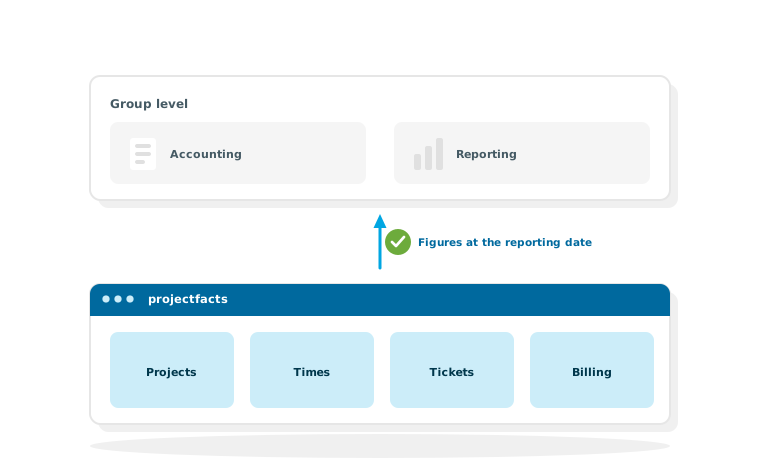
The clean route: two levels
What stands at the end is not a contest but a split that lets both sides have what matters to them.
What each side gets
The group gets its figures in its own system, at the reporting date, in its own format and without manual submissions. The company keeps the processes it runs its business with, and the coverage of the German requirements. A handover of this kind is set up within weeks rather than quarters, and it can be extended at any time later on if the group does need more data after all.
If it turns out in the end that a replacement is the right decision, the same applies in the other direction: all data can be pulled out through the API and the export functions. A factual review does no harm even when it goes against us.
We will talk to your group IT
Instead of carrying arguments back and forth: a joint meeting with you and the people responsible in the group. We show which data can be handed over and how, and answer the technical questions directly. Free of charge and without obligation.
Arrange a joint meetingStill have questions? We have the answer.
Are you facing a decision like this, or would you like to discuss the technical options for handing over data in detail? Talk to us, at short notice if need be.